
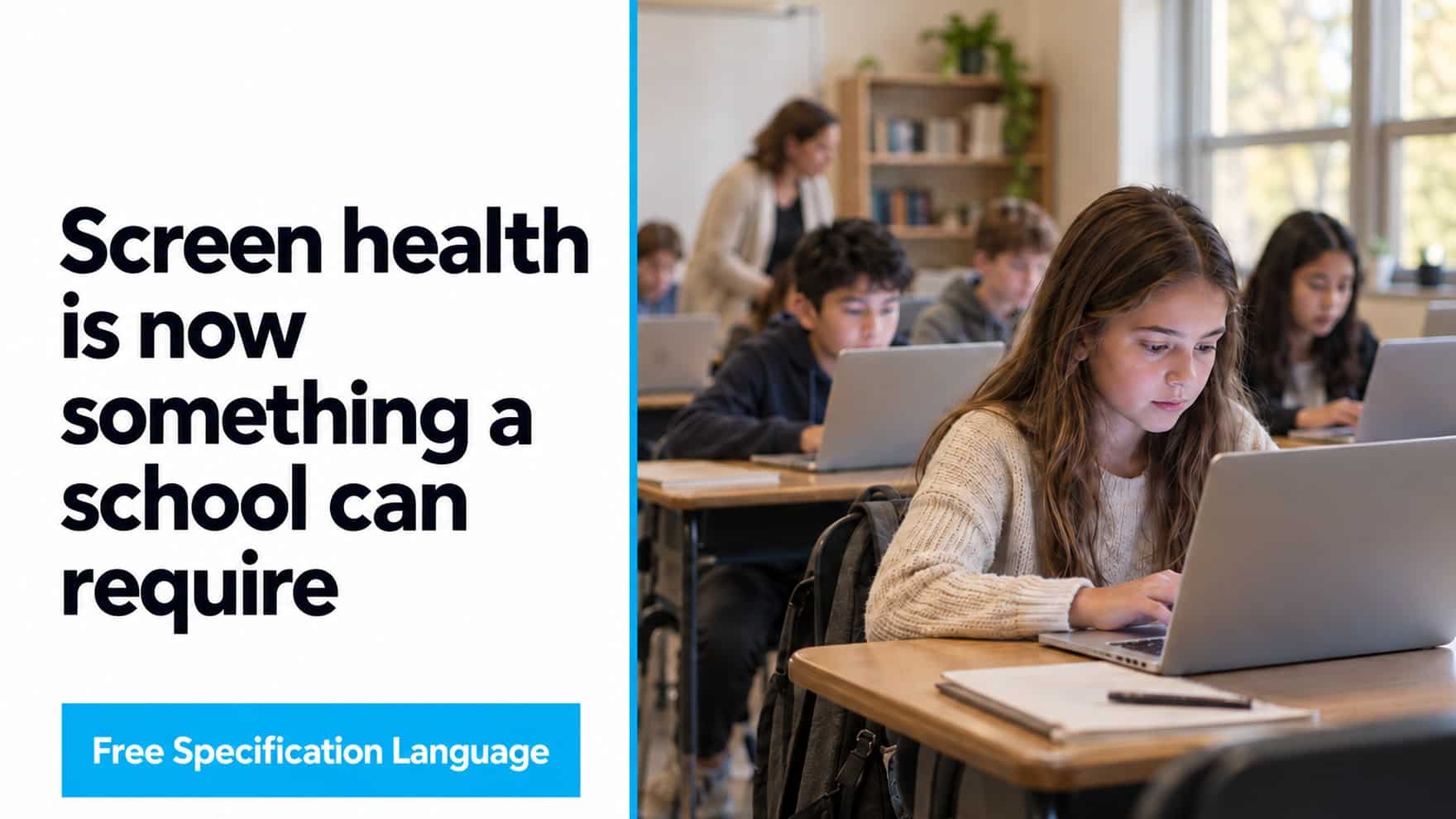
Any district, agency or employer can now write measurable screen health performance into its next device purchase at no cost — and any parent can ask their own school to do it
MINNEAPOLIS, Sept. 22, 2026 — Eyesafe, the worldwide leader in screen health technology and standards, today published two free resources that together close the gap between what the research says about screens and what organizations actually buy.
The scale of the gap. In the United States alone, roughly 17,700 operating public school districts serve 49.5 million students. Worldwide, about 1.4 billion children are enrolled in primary and secondary education, and schools are forecast to take delivery of approximately 43 million notebooks, Chromebooks and tablets during 2025 alone. Every one of those purchases specifies processor, memory, screen size and durability. Almost none of them specify anything about the light the screen puts into a child’s eyes.
Free health specification language for organizations
Eyesafe.com/specify gives purchasing organizations turnkey specification language: paste-ready requirement blocks for screen protection and for displays, the published RPF and CPF grade tables, five procurement framings — education, state and cooperative, federal, healthcare and enterprise — and a supplier response form that returns every bid in a comparable format. The complete Screen Health Specification Pack downloads with no registration, no email address and no obligation to buy any Eyesafe product.
One click to ask your school for health-based electronics
eyesafe.com/protect allows parents to quickly and easily ask their school for Eyesafe. A parent selects their state, finds their school district — all 17,719 US public districts are searchable — and a claims-safe letter is written for them, ready to send from their own email in about two minutes. The page suggests who to send it to and never collects, stores or transmits any information about the parent or the child.
“Organizations specify everything about the screens they buy — resolution, color, brightness, energy use — except the thing their people look at all day,” said Justin Barrett, founder and CEO of Eyesafe. “We wrote the requirement language, published the grade tables behind it, and made it free. And we gave parents a way to ask for it in two minutes. Bringing health to computing should not require a consultant. It should require a paragraph.”
Why measurement matters. “Blocks blue light” appears across the category, but the figures behind it rarely state the wavelength range they were computed over, the test method, or any independent verification. The Eyesafe requirements name both: 435–440 nm, the peak of the blue-light hazard range identified by ICNIRP (2013) and ANSI (2015), measured by Radiance Protection Factor (RPF®); and 480–500 nm, the range that drives melatonin suppression per CIE S 026/E:2018, measured by Circadian Protection Factor (CPF). Both are computed from a full spectral measurement, reproducible in any accredited laboratory, and published as graded tables — so a buyer can specify good-better-best the way they already do for other rated components.
The evidence, published alongside. Eyesafe also expanded its research library at eyesafe.com/research with sections organized by audience — children and education, and workplace and commercial — each citation checked against its primary source. Among the findings districts cite most: children’s clearer lenses and larger pupils deliver approximately 1.5 times the circadian-active light dose to the retina compared with adults, with correspondingly greater melatonin suppression (Eto et al., 2021, Ophthalmic & Physiological Optics); under identical evening light, children’s melatonin suppression is roughly double that of adults (Higuchi et al., 2014); and across more than 125,000 children, bedtime device use was associated with more than double the odds of inadequate sleep (Carter et al., 2016, JAMA Pediatrics).
Partner voices
“Over the past several years, I’ve had countless conversations with schools, healthcare organizations, and employers about the impact of increased screen time on the people they serve. One of the biggest challenges has been the lack of a practical and measurable way to evaluate screen health as part of the technology purchasing process. Initiatives like Eyesafe’s specification framework help move the conversation from general awareness to actionable standards. Giving organizations an evidence-based approach to incorporate screen health considerations into procurement decisions is a positive step for the industry and, most importantly, for the people who rely on technology every day.”
— Mitchel Macauley, GM, North America 3PO Accessories Business, Lenovo
“Scientific testing has confirmed that children’s eyes transmit more of this light to the retina than adults’ do, and their circadian systems respond more strongly to it in the evening. That is not a reason for alarm; it is a reason for design. When the evidence is this consistent, the responsible response is to reduce avoidable exposure where we reasonably can, and to hold that reduction to a number rather than a claim.”
— Dr. David Friess, OD, Eyesafe Health Advisory Board
Solutions that already meet the requirement: Lenovo
A specification is only useful if products exist that can meet it. They do, and they are shipping today.
Lenovo offers Eyesafe screen protection for its education Chromebooks — built to manage the blue light of most concern while keeping the display clear and color-accurate, and adding drop, scratch and impact protection for devices that travel home in backpacks every night. For a district writing the specification language into its next purchase, this is what a conforming, orderable product looks like.
Lenovo’s Eyesafe range, the supporting materials and the ordering details are collected in one place at eyesafe.com/lenovo3po.
Written to be met by more than one supplier. Every specification block keeps brand-name-or-equal treatment and accepts test reports from any ISO/IEC 17025-accredited laboratory as an alternative to certification. Conforming displays and screen protection have shipped at scale since 2019 from manufacturers including Dell, HP, Lenovo, Acer, BenQ and LG Display, with more than 350 million screens carrying Eyesafe technology worldwide.
Both resources are available now at eyesafe.com/specify and eyesafe.com/protect.
Why there was nothing to ask for before
Every district device purchase specifies the same short list. Processor. Memory. Screen size. Battery. Durability, because the devices go home in backpacks. Warranty, because some of them come back broken.
That list is not short because buyers do not care about the rest. It is short because the rest had no language. “Low blue light” is a marketing phrase, not a requirement. You cannot put it in a solicitation, you cannot hold a supplier to it, and you cannot compare two bids that both claim it. A buyer who wanted to ask the question had no sentence to ask it in.
That is the gap these two resources close — not with a new product, but with wording and a number behind it.
A requirement only one company can meet is not a standard
It is worth being direct about the obvious objection: Eyesafe sells into this category, and Eyesafe wrote the language.
So the language is written to be survivable without us. Every specification block keeps brand-name-or-equal treatment. Every one of them accepts a test report from any ISO/IEC 17025-accredited laboratory as an alternative to certification. Any manufacturer can meet these requirements, and any accredited lab can check whether they did.
A requirement that only one company can meet is not a standard. It is a purchase order with extra steps.
How narrow this actually is
The two ranges the requirements name sit inside the high-energy visible band, 380–500 nm, as divided into sub-bands by the ANSI ASC Z80 Spectral Bands Task Force — work Eyesafe contributed to.
Two narrow bands, out of the entire visible spectrum. Everything else is left alone. That is why a conforming screen still looks like a screen, and it is the reason a measured requirement can be written at all: it asks a supplier to do something specific and checkable, not to make a screen dimmer or yellower.
Start here
If you buy devices: eyesafe.com/specify — take the language and use it with any supplier.
If you are a parent: eyesafe.com/protect — about two minutes.