
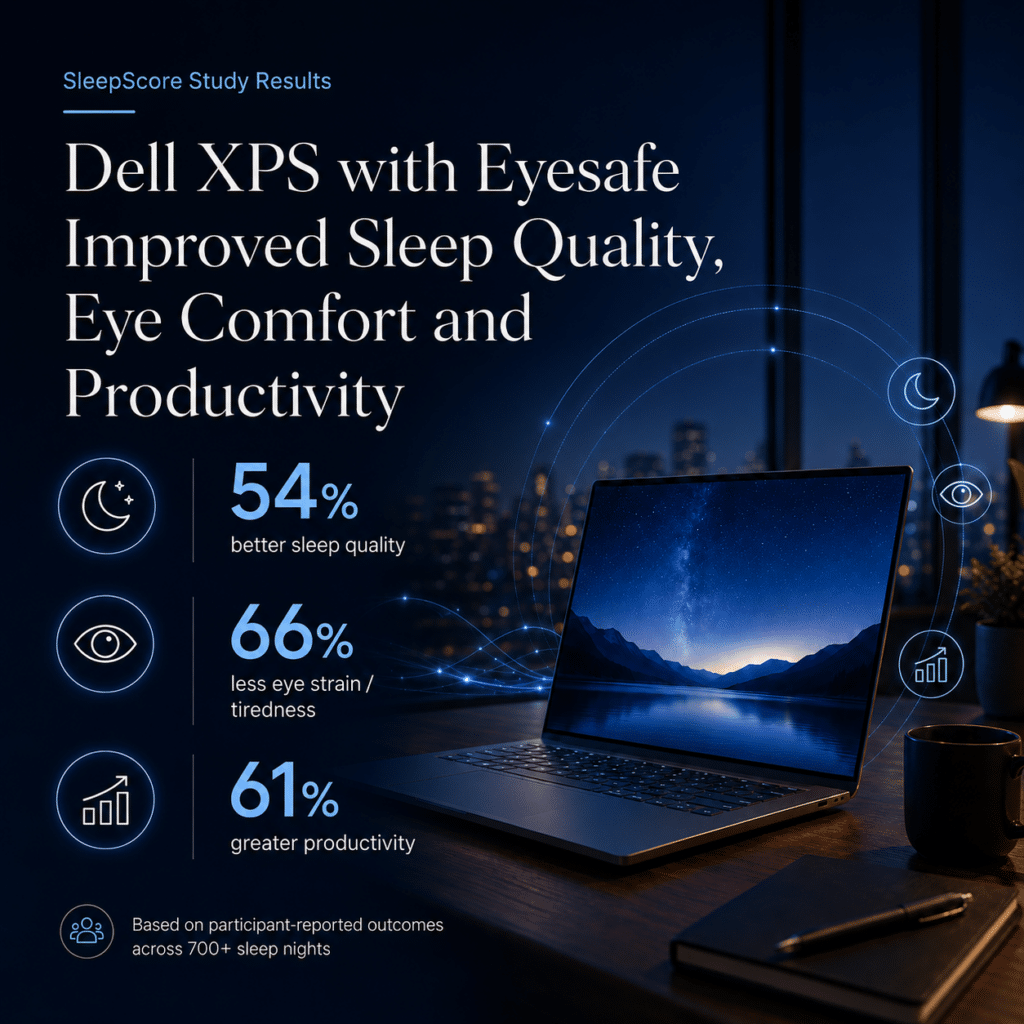
A 9-week, 700+ sleep-night in-home study found Dell XPS with Eyesafe Display and Dell XPS with Eyesafe IQ improved key participant-reported outcomes versus participants’ previous standard laptops.
For many people, laptop use does not end when the workday ends. Laptops are used well into the evening for work, streaming, browsing, school, communication and entertainment. That makes the screen experience after dark increasingly important.
Eyesafe and Dell have continued to advance premium display experiences designed to support both visual performance and user well-being. In a recent in-home study conducted with SleepScore Labs, Dell XPS with Eyesafe technology was evaluated among evening laptop users to better understand how advanced display and software light-management technologies may impact sleep-related experience, eye comfort and productivity.
Across more than 700 sleep nights, participants reported meaningful improvements after switching from their previous standard laptops to Dell XPS with Eyesafe Display and Dell XPS with Eyesafe IQ. The strongest participant-reported outcomes were seen with Dell XPS with Eyesafe IQ, including up to 54% better perceived sleep quality, 66% less eye strain / tiredness and 61% greater productivity.
Why evening laptop use matters
Evening screen use is now part of everyday life. People use laptops after sunset to finish work, answer emails, stream content, connect with family and friends, shop, study and browse online.
The challenge is that nighttime light exposure can influence how comfortable a screen feels in low-light environments and how users feel before bed and the next morning. The SleepScore Labs report notes that light exposure at night has been associated with negative impacts on sleep and health, in part because nighttime light can influence melatonin release. The report also notes that electronic device use before bed may increase blue light exposure, which can affect sleep-related outcomes.
For premium devices, the goal is not simply to make screens look warmer or dimmer. Users still expect color quality, clarity, productivity and a premium viewing experience. The opportunity is to create display and software technologies that support visual comfort and healthier evening screen habits without compromising the user experience.
About the study
SleepScore Labs conducted a 9-week, in-home validation study. Participants were evening laptop users who regularly used a laptop for more than one hour after sunset. To be eligible, participants were required to own and actively use a laptop, self-report eye strain and not already use a blue-light filtering screen protector.
The study followed a three-phase structure:
Weeks 1–3: Participants used their own standard laptops as the baseline condition.
Weeks 4–6: Participants used Dell XPS with Eyesafe Display.
Weeks 7–9: Participants used Dell XPS with Eyesafe Display plus Eyesafe software, referred to externally as Eyesafe IQ.
The study collected both objective sleep data and survey data. Objective sleep was measured using SleepScore Max, a validated non-contact sleep monitor. Survey data included daily self-reports and end-of-period questionnaires.
What the study measured
The study evaluated three categories of outcomes:
Objective sleep measures, including sleep quality, sleep onset latency, total sleep time, awakenings, REM sleep, deep sleep and sleep efficiency.
Daily self-reported outcomes, including sleep quality, feeling refreshed, eye strain, productivity and feeling well-rested.
End-of-period experience outcomes, including ease of falling asleep, high sleep-quality nights, satisfaction with sleep, visual comfort, recommendation and continued-use intent.
The key statistically significant improvements were found in participant-reported outcomes, including perceived sleep quality, eye strain / tiredness, morning well-restedness and productivity.
Dell XPS with Eyesafe Display improved key outcomes
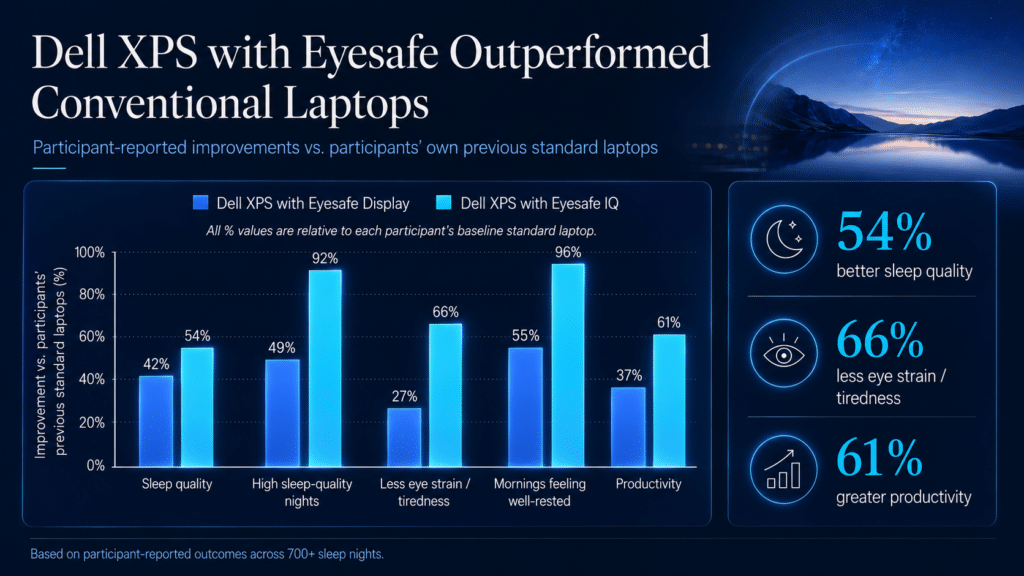
When participants switched from their previous standard laptops to Dell XPS with Eyesafe Display, they reported meaningful improvements across multiple evening-use outcomes.
Compared with their own standard laptops, participants reported:
- 42% better perceived sleep quality
- 49% more high sleep-quality nights
- 27% less eye strain / tiredness
- 55% more mornings feeling well-rested
- 37% better productivity
Participants also reported strong user experience outcomes with Dell XPS with Eyesafe Display. 81% said the screen was more comfortable in low-light conditions, 90% rated visual comfort better or much better than their previous laptop, and 95% said they would recommend the laptop.
These findings show that display-level innovation can improve the evening laptop experience in ways users can feel and report, while preserving the premium viewing quality expected from Dell XPS.
Dell XPS with Eyesafe IQ delivered the strongest results
The strongest participant-reported results were seen when participants used Dell XPS with Eyesafe IQ.
Compared with their previous standard laptops, participants reported:
- 54% better perceived sleep quality
- 92% more high sleep-quality nights
- 66% less eye strain / tiredness
- 96% more mornings feeling well-rested
- 61% better productivity
User experience results were also strong. 95% enjoyed using the Dell XPS with Eyesafe IQ configuration, 95% would recommend the software, 95% planned to continue using it, and 100% rated visual comfort better or much better than their previous laptop.
These results show the added value of combining Eyesafe Display with Eyesafe IQ. The display hardware improved key outcomes, while the intelligent software layer delivered the strongest overall participant-reported gains.
What is Eyesafe IQ?
Eyesafe IQ is intelligent screen-light software for premium displays. It is designed to dynamically manage display light in real time, supporting visual comfort and healthier evening screen habits while preserving the color, clarity and premium viewing experience users expect.
Traditional blue light filters can visibly shift the screen toward yellow or orange tones. Eyesafe IQ is designed to make more subtle adjustments, helping reduce disruptive blue light exposure without the obvious visible color shift associated with traditional filters.
For device makers, Eyesafe IQ provides a software-based intelligence layer that can help differentiate premium devices through research-backed visual comfort and wellness features. The press release describes Eyesafe IQ as Eyesafe’s proprietary software intelligence layer for dynamic display light management.
Why these results matter
The Dell XPS + Eyesafe study reflects a broader shift in consumer electronics. Premium devices are increasingly expected to deliver more than performance, portability and design. Users also want products that support how they live, work and use technology throughout the day and into the evening.
The results support three important takeaways.
First, screen health belongs in premium device design.
Participants reported better perceived sleep quality, less eye strain / tiredness, improved morning well-restedness and better productivity after switching to Dell XPS with Eyesafe technology.
Second, software can add meaningful value to display hardware.
Dell XPS with Eyesafe Display improved key participant-reported outcomes, while Dell XPS with Eyesafe IQ delivered the strongest results across the study’s core self-reported measures.
Third, real-world validation matters.
This was a 9-week in-home study across more than 700 sleep nights, providing insight into how the technology performed in participants’ actual evening routines, not only in a controlled lab setting.
A new standard for healthier evening laptop use
Dell XPS with Eyesafe technology represents an important step forward in premium display innovation. It shows how display hardware and intelligent software can work together to support a better evening laptop experience.
The study results show that Dell XPS with Eyesafe Display and Dell XPS with Eyesafe IQ improved important participant-reported outcomes compared with participants’ own previous standard laptops. Those outcomes included perceived sleep quality, eye strain / tiredness, morning well-restedness and productivity.
As screen time continues to extend into evening routines, technologies like Eyesafe Display and Eyesafe IQ can help define a new standard for healthier, more comfortable digital experiences.
Learn more
Read the full press release: Dell XPS + Eyesafe Set a New Standard for Healthier Evening Laptop Use in SleepScore Study
Explore Eyesafe IQ: Intelligent screen-light software for premium displays
Learn more about Eyesafe technology: Science-backed screen health and blue light management solutions
Note: Results are based on participant-reported outcomes from the SleepScore Labs validation study. Objective sleep measures did not significantly change.