
The average American child between the ages of 8 and 18 now spends more than seven hours a day in front of a screen — and that figure does not include classroom time. Schools have gone one-to-one with tablets and Chromebooks. Pediatricians have moved telehealth onto a phone. Bedtime, for too many kids, ends with a glow on the pillow.
What that glow contains is not a footnote. It’s a public health question the display industry has been slow to answer honestly.
A child’s eye is not a small adult eye
The single most important — and least understood — fact about pediatric vision is that a child’s eye is optically different from an adult’s. It is more transparent.
The crystalline lens of an adult naturally yellows over decades, gradually filtering out shorter wavelengths of visible light before they reach the retina. By age 60, that yellowing means the lens absorbs the majority of incoming blue light. By age 70, very little reaches the back of the eye at all.
A child does not have that filter yet.
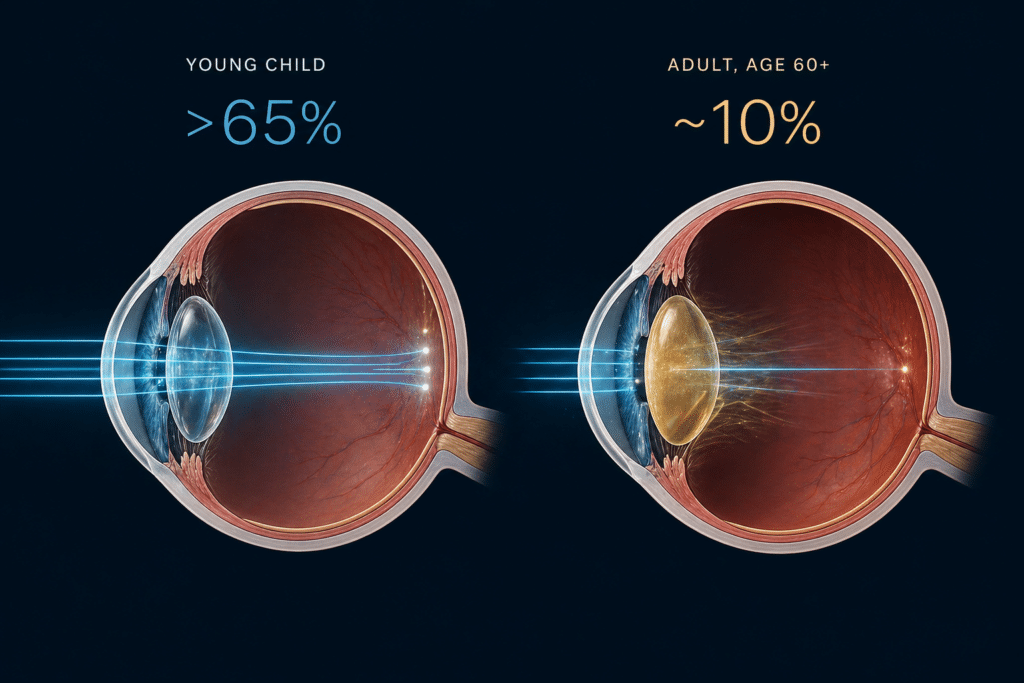 Peer-reviewed measurements show that more than 65% of blue light reaches the retina in a young child’s eye, compared to a fraction of that in older adults. In infants, transmission of 400 nm light is roughly 25 times higher than in a 70-year-old. Pupils are larger. Lenses are clearer. Macular pigment, the carotenoid layer that helps neutralize light-induced oxidative stress in the retina, is still developing through the early years of life.
Translation: when light hits a child’s display, more of it — and more of the most energetic part of it — penetrates all the way to the retina.
What we know, and what we don’t
Eyesafe takes scientific honesty seriously, so it’s worth being precise about what’s settled and what isn’t.
What is well established:
- Evening light exposure suppresses melatonin and delays sleep onset. JAMA Pediatrics meta-analyses have linked screen use within an hour of bedtime to delayed sleep and shorter sleep duration in children.
- Sleep is a cornerstone of childhood development — neurological, metabolic, behavioral, and academic.
- Pediatric digital eye strain is real and increasingly common: dry eyes, headaches, blurred vision, focusing difficulty.
- Myopia prevalence in children has risen sharply over the past two decades, correlated with increased near-work and reduced outdoor time.
What remains under active study:
- The long-term cumulative effect of decades of LED display exposure beginning in early childhood. The honest answer: this generation is the first to grow up with screens in hand from preschool onward, and the longitudinal data simply does not exist yet.
- The precise dose-response relationship between specific blue-light wavelengths and retinal aging.
What’s important is the asymmetry of the bet. The biology of the developing eye is well understood. The exposure pattern is unprecedented. Waiting forty years for the longitudinal data before acting is not a neutral choice — it is a choice.
The wavelengths that matter
Most of the public conversation treats “blue light” as a single thing. It isn’t. The 400–500 nm band contains very different biological actors, and lumping them together is what has made some blue-light products easy to dismiss.
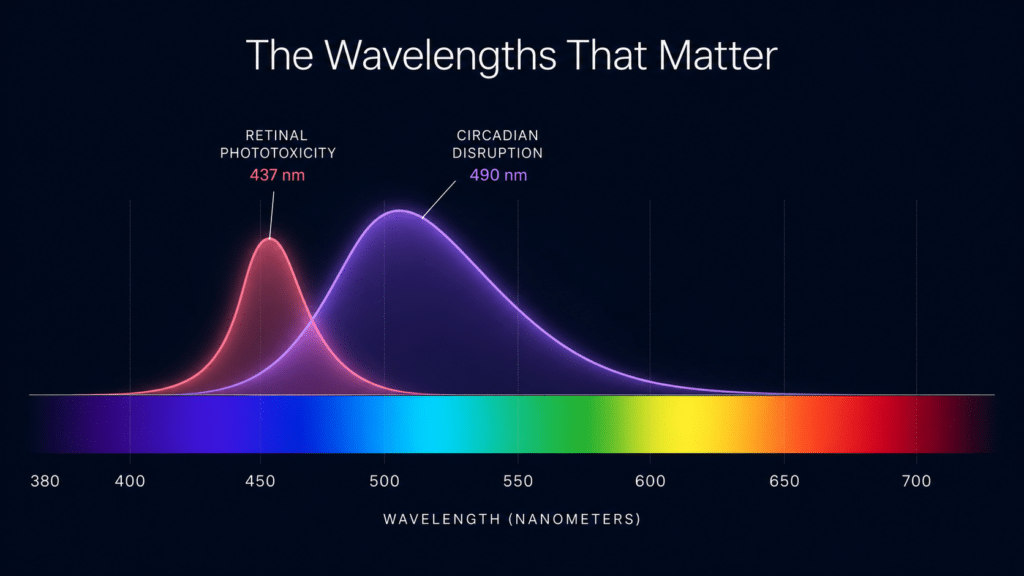 Two narrow regions account for nearly all of the biological concern:
- 435–440 nm — the wavelengths most associated with retinal phototoxicity in laboratory and animal studies.
- 480–500 nm — the wavelengths most responsible for melatonin suppression and circadian disruption.
Filtering broadly across the entire blue band degrades color and reduces visual performance without meaningfully improving protection. Filtering precisely — at the wavelengths where the biology actually lives — does the opposite.
This is the foundation of Eyesafe’s Digital Wellness Optics platform: spectral filtration aligned to the specific pathways where light meets biology, validated through measurable standards (RPF for retinal phototoxicity, CPF for core protection, DPF for the consumer-facing protection factor across the 400–500 nm band). It is also why Eyesafe technology is built into displays from Dell, HP, Samsung, Lenovo, and LG — and into screen protectors and optical lenses.
We do not believe parents should have to choose between letting their kids learn on a screen and protecting how those screens are designed.
What parents can actually do
The American Academy of Pediatrics’ published guidance is the right starting point: no screen time for children under 18 months (other than video chat); no more than one hour per day for ages 2–5; thoughtful, balanced use thereafter. Outdoor time matters enormously — both for sleep regulation and for slowing myopia progression.
Beyond that, a few practical principles:
Treat the hour before bed as sacred. This is the single most evidence-supported intervention. Devices off, or at minimum on a warm, dim setting. Melatonin is what makes children sleep, and light is what suppresses it.
Look for the technology built into the device, not just glasses worn over the device. Display-level blue light management, when properly engineered, protects without requiring kids to wear or remember anything.
Check the science behind the certification. Generic “blue light blocking” claims with no underlying spectral data, no clinical validation, and no measurable standard are exactly the kind of thing that gives the category a bad name. Look for products certified to a published standard.
Get regular eye exams. Myopia control is one of the most effective interventions available today, and the right time to start is before a child needs glasses, not after.
Why this matters to us
Eyesafe started in 2016 with a simple premise: as light from screens replaced light from the world, somebody needed to think seriously — biologically, optically, scientifically — about what that meant for the people staring into them. Children were always going to be the most exposed and the most vulnerable.
Nine years and 50+ patents later, that premise has become a global standard. Today’s children are growing up with Eyesafe-certified displays in their classrooms, Eyesafe-licensed screen protectors on their phones, and an emerging generation of optical lenses built on the same science. We think that matters.
The display industry has spent thirty years optimizing for color, brightness, and resolution. The next thirty will be defined by how it optimizes for the humans on the other side of the glass — starting with the smallest ones.
Eyesafe is the global standard for light health in electronics, with technology integrated into displays, screen protectors, and optical lenses through partnerships with the world’s leading device makers. Learn more at eyesafe.com.