
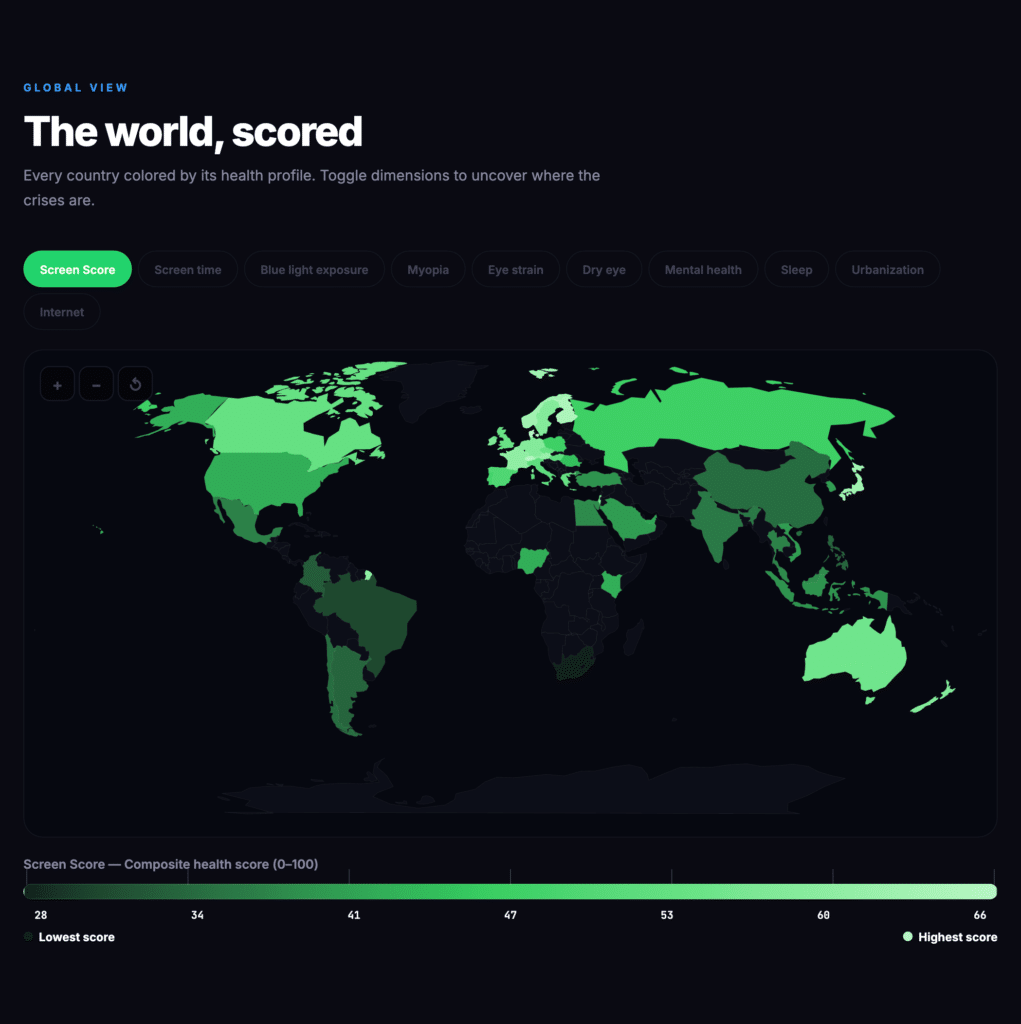
MINNEAPOLIS — March 17, 2026 — Eyesafe, the global leader in blue light management and screen health solutions, today released the World Screen Health Report 2026, a first-of-its-kind interactive study ranking 50 countries across nine key indicators of screen-related health impact.
The report arrives at a critical moment: the average person now spends 6 hours and 40 minutes per day looking at screens, while Gen Z averages more than 9 hours daily. The consequences are measurable and growing — 69% of adults report digital eye strain symptoms, and 1 in 3 children worldwide is now myopic.
A New Framework for Measuring Screen Health
The World Screen Health Report introduces a composite Screen Score for each country, calculated from nine weighted indicators: screen time, blue light exposure, myopia prevalence, digital eye strain, dry eye disease, mental health impact, sleep disruption, urbanization rates, and internet penetration. Together, these metrics paint a comprehensive picture of how digital life is affecting populations around the world.
Key Findings
Switzerland and Denmark lead the rankings, each earning a Screen Score of 66 out of 100, followed by Finland (64), Norway (62), and Japan (62). These countries benefit from a combination of lower average screen times, stronger public health infrastructure, and proactive policies around digital wellness.
The United States ranks 27th out of 50 countries with a score of 42, reflecting the nation’s high screen time averages and elevated rates of digital eye strain and myopia among younger populations.
South Africa, Brazil, Colombia, Argentina, and the Philippines round out the bottom of the rankings, where rapid smartphone adoption has outpaced the development of public health frameworks for screen-related conditions.
Five Critical Insights
The report surfaces five data-driven insights that challenge common assumptions about screen health:
- Screen time is the primary driver of eye strain — Countries with the highest daily screen averages show proportionally higher rates of digital eye strain symptoms, confirming a direct relationship between exposure duration and ocular discomfort.
- Sleep deprivation and myopia cluster together — Nations struggling with sleep quality also tend to report higher myopia prevalence, suggesting shared underlying causes rooted in screen behavior.
- Blue light exposure erodes sleep quality — The data reveals a consistent pattern: populations with greater blue light exposure from screens report worse sleep outcomes, underscoring the need for hardware-level blue light management.
- Urbanization predicts myopia better than screen time — While screens contribute, urban environments — with less outdoor light exposure and more near-work demands — emerge as a stronger predictor of myopia rates.
- Dry eye and eye strain share a common cause — The report finds these conditions are tightly correlated, driven by reduced blink rates during prolonged screen use.
An Interactive Experience
The full report is available as an interactive web experience featuring a global choropleth map, sortable country rankings, scatter plot analyses, and detailed visualizations of each health indicator. The report draws on peer-reviewed research and publicly available health data from organizations including the World Health Organization, JAMA Ophthalmology, The Lancet, and Sleep Foundation.
About Eyesafe
Eyesafe is the world leader in blue light management, offering display-level and accessory solutions that reduce harmful high-energy visible light while maintaining color quality. Eyesafe technology is integrated into products from leading manufacturers including Dell, HP, Lenovo, and ASUS. The company holds over 50 patents in blue light mitigation technology across LCD, OLED, MicroLED, and AR/VR display platforms. Learn more at eyesafe.com.
Media Contact:
Eyesafe Communications
[email protected]